Block puzzles are easy to start because the rules are clear: place shapes on a board and use the available space well. The challenge comes from what happens after each move. A placement that looks fine now can make the next piece difficult.
That is why space management matters. You are not only placing the current block. You are shaping the future board.
Puzzlepia’s Daily Block Puzzle is a small starter puzzle for practicing safe placement. You can also visit the Blockzzle page for its separate browser game.
Keep the board open
The strongest beginner habit is to protect open space. A board with one large open area is usually easier to play than a board full of tiny gaps.
Before placing a block, ask: does this move keep useful space available? If the answer is yes, the move is probably safer. If the move splits the board into awkward pockets, think again.
Open space gives you choices. Choices are valuable because future pieces may not fit exactly where you expect.
Compare two moves on the same board
Here is a small placement exercise. Purple cells are occupied; white cells are empty. Columns run A to D and rows run 1 to 4. Place a single block first, then a 2x2 square. Nothing clears in this exercise.
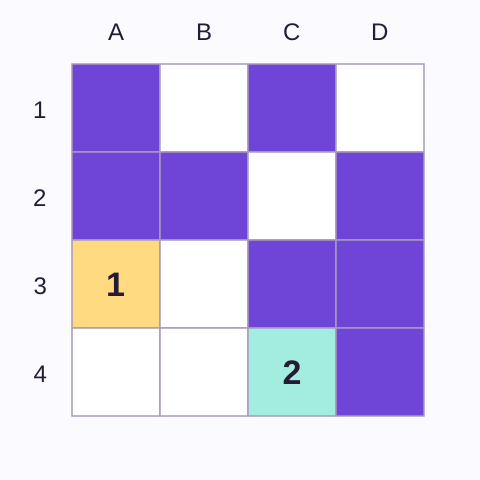
Choice 1: A3. Choice 2: C4. Which leaves room for the square?
Both marked cells accept the single block. But choice 1, at A3, blocks the only remaining 2x2 space: A3, B3, A4, and B4. The other empty cells do not form a complete square. Counting empty cells alone would miss that problem.
Choice 2, at C4, keeps that square open. Place the single block there, then put the square at A3. Both pieces fit, with no overlap. You have not created more empty cells; you have preserved the shape you need.
This is why “always place the biggest piece first” is only a starting suggestion. Here the exercise sets the order, and planning the smaller piece correctly is enough. In a game that clears lines, recheck the board after a clear because the available shapes may change.
Try a different board in Find the Only Square Space. Its hint and explanation stay closed until you open them.
Avoid isolated gaps
An isolated gap is a small empty space surrounded by filled cells. Single-cell gaps are especially troublesome because many block shapes cannot use them.
A one-cell hole may not seem important, but it can remain stuck for several turns. As the board fills, that hole becomes wasted space.
When you place a piece, look at the shape of the empty area left behind. If you create a small pocket that only one rare piece can fill, the placement may be risky.
In a simple starter puzzle, this is easy to see. A clean placement keeps the board readable. A messy placement can make the remaining space feel tight.
Plan around large pieces
Large pieces need room. If you fill the board without keeping a wide area open, a large piece may become impossible to place.
A useful habit is to reserve at least one clear area for bigger shapes. You do not need to know every future piece. You only need to keep the board flexible enough that larger pieces still have a chance.
This is especially important in block games where pieces arrive in sets. If you can see three pieces at once, place them in an order that leaves room for the largest or most awkward one.
Use corners carefully
Corners can be helpful because they give blocks a natural boundary. Placing a square into a corner often keeps the center open. A straight piece along an edge can also be efficient.
But corners can become traps if you create jagged edges around them. A corner with an odd missing cell may be hard to repair.
Try to build clean shapes along edges. Smooth boundaries are easier to work with than uneven ones.
Think one move ahead
You do not need a deep strategy to enjoy block puzzles. Thinking one move ahead is enough for many beginner situations.
Look at the current piece and the pieces still waiting. If you place this block here, where can the next block go? If the answer is unclear, test another placement in your mind.
This small pause can prevent many common mistakes. It also makes the puzzle feel more intentional and less random.
Do not rush the first move
The first move often sets the tone. If you place the first block in a way that blocks useful space, the board may become awkward immediately.
Take a moment to look at all pieces before placing anything. Start with a move that leaves the widest range of options.
On Puzzlepia’s Daily Block Puzzle, the goal is simply to place all pieces. That makes it a gentle place to practice reading the board before tapping.
Recover calmly
Every player makes imperfect placements. If the board becomes messy, focus on recovery. Look for the largest open area and protect it. Try not to make isolated gaps worse. Place awkward pieces where they do the least damage.
Block puzzles reward calm adjustments. You do not need a perfect board to keep playing well.
If you want to practice, start with Daily Block Puzzle and then explore Blockzzle through the Puzzlepia games hub. For a fuller browser puzzle session, you can play Blockzzle online from the official Blockzzle site. After that, you can view the Blockzzle leaderboard as a secondary reference for submitted scores.