Ring puzzles are satisfying because they combine color, shape, and placement in a very readable way. A ring has a color. It has a size. It belongs in a cell. Those simple ideas can create a puzzle that feels calm but still thoughtful.
Puzzlepia’s Daily Ring Puzzle is a compact starter version. It keeps the rules small: choose a ring, place it into a compatible cell, and complete the tray. You can also visit Ringzzle to learn about the related BornstarSoft game page.
If you are new to ring puzzles, here are the basics.
Understand the sizes
Many ring puzzles use different ring sizes, such as small, medium, and large. A cell may be able to hold one ring of each size. That means a large ring and a small ring can share a cell, but two small rings cannot.
This size rule is easy to understand visually. The rings nest inside each other, so the board can show multiple layers at once.
When you play, check the size before placing. A color may look perfect, but the cell still needs to have room for that size.
Read three cells before choosing
Use this small example to separate color from size. Each cell has one small, one medium, and one large position. A solid ring occupies a position; a dashed outline marks an empty one. S, M, and L mean small, medium, and large.
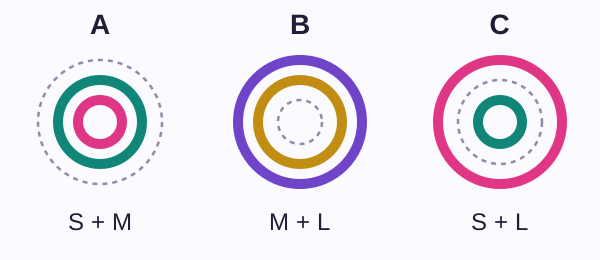
A: S + M occupied. B: M + L occupied. C: S + L occupied.
You are holding a large gold ring. Where can it go?
Cell A is the only compatible choice. Its large position is empty, even though neither existing ring is gold. Cell B already contains a large purple ring, so its gold medium ring does not make the placement valid. Cell C also has its large position occupied.
Now consider a small pink ring on the original board. It fits B, whose small position is empty. The pink ring already in A is a reason to reject A: it occupies the small position you need. Color cannot override an occupied size.
This example uses placement only. Puzzlepia’s Daily Ring Puzzle finishes when all five tray rings are placed; it does not require a line clear. Ringzzle has its own color-line rules, described on the official game site. Read those rules before transferring a matching strategy between games.
For a complete three-piece exercise, try Three Rings, Three Spaces.
Watch color patterns
Color is the most immediate part of a ring puzzle. Matching colors can create clean lines, sets, or satisfying board patterns depending on the rules of the game.
Even when a starter puzzle does not use full line-clearing logic, color still matters. It helps the board feel organized. It also makes the puzzle easier to read at a glance.
If you are deciding between two placements, ask which one creates a clearer color pattern. A tidy board is often easier to continue.
Keep cells flexible
A flexible cell can accept more future pieces. For example, if a cell has only a large ring, it may still accept medium and small rings. If a cell already has all sizes filled, it is complete but no longer flexible.
This does not mean you should avoid filling cells. Completion is part of the fun. But early in a puzzle, it can help to keep several cells open for different sizes.
Flexibility gives you more options when the next ring appears.
Place awkward pieces early
Some rings are harder to place than others. A color may have fewer useful spots. A size may fit in fewer cells. When a piece feels awkward, consider placing it earlier instead of saving it for last.
This idea appears in many puzzle types. Difficult pieces become even more difficult when the board gets crowded.
In a small starter puzzle like Daily Ring Puzzle, the tray is visible, so you can look at all pieces before choosing. That makes it easier to plan a simple order.
Think about layers
Ring puzzles are not only about positions. They are also about layers. A large ring changes the outside of a cell. A medium ring changes the middle. A small ring changes the center.
Good placement often considers both the cell and the layer. If two colors might work in the same cell, choose the one that leaves better options for the remaining sizes.
This kind of thinking is light, but it makes the puzzle more interesting.
Keep the board readable
Because ring puzzles are visual, readability matters. Try not to scatter colors randomly if you can avoid it. Grouping related colors or building a clear line can help you see the board more quickly.
Readable boards are easier to enjoy. They also make mistakes easier to notice before they become a problem.
Enjoy the small finish
Ring puzzles can feel satisfying even when they are short. Placing the final ring gives the board a completed look. That visual finish is part of the appeal.
Puzzlepia’s ring starter is intentionally simple, but it introduces the basic rhythm: choose, place, check, complete.
Try the Daily Ring Puzzle for a quick placement challenge, then visit Ringzzle or play Ringzzle online for the separate color rings game.